
Two agencies quote you for the same Meta ads job. One sends a flat number that doesn’t move no matter what you spend on ads. The other sends a percentage, so the invoice grows automatically the second you increase your budget. Founders usually pick based on which number looks smaller this month. That’s the wrong test. The right test is which model’s incentives are actually pointed at your result, and the maths on that is simpler than either agency will tell you.
Most AU eCom founders comparing quotes never actually run the numbers side by side; they eyeball a percentage against a flat dollar figure and pick whichever feels less scary at the spend level they’re at today. That’s fine at the spend level you’re at today. It stops being fine the moment your ad budget grows, which is the entire point of running ads in the first place.
The two models, plainly
A flat fee is a fixed monthly management charge, set by the size and complexity of the account, not by how much you spend on ads. You could double your budget next month and the management fee wouldn’t change.
Percentage-of-spend charges a cut of whatever you put through the ad account, commonly somewhere in the 10–20% range depending on the agency and the spend tier. Spend more, the agency earns more, whether or not the extra spend earned you anything.
The maths, worked with round numbers
Say a flat fee sits at $1,500 a month (this is illustrative, not a quote. HC’s actual published tiers are at healeycommerce.com.au/pricing) and a percentage-of-spend deal runs 15%, roughly the middle of the common industry range. Here’s what each costs an AU Shopify store at three real spend levels:
- $5,000/month ad spend: flat fee $1,500. Percentage $750. Percentage wins.
- $10,000/month ad spend: flat fee $1,500. Percentage $1,500. Break-even.
- $20,000/month ad spend: flat fee $1,500. Percentage $3,000. Flat wins, by double.
The break-even point is just the flat fee divided by the percentage rate. Below it, percentage looks cheaper. Above it, flat wins and keeps winning as spend climbs, because the flat fee stops moving and the percentage never does. Most AU eCom stores that survive their first year of paid Meta ads end up spending well past that crossover, which is exactly when the percentage model starts quietly costing more for the same work. Nobody re-quotes you when you cross that line. The fee just keeps climbing, invoice after invoice, and most founders never sit down and work out at what point it overtook the flat option.
The industry’s own numbers say percentage-of-spend is already fading
This isn’t just HC’s read on it. In the Global Agency Landscape survey run by SoDa and Productive, commission-based pricing (the percentage-of-spend model, in agency terms) accounted for just 1% of total agency revenue, against roughly 50% from fixed-fee project work and 44% from retainers. Agencies that still quote a straight percentage are increasingly the exception, not the standard, even though it’s still what a lot of AU Meta ads shoppers expect to see first.
Why it fades: the incentive nobody prices in
A percentage-of-spend fee grows for reasons that have nothing to do with your account. Australia’s internet advertising market grew 14.0% year on year to $19.8 billion in FY26, according to the IAB Australia Internet Advertising Revenue Report, compiled with PwC. When the whole market gets more expensive to advertise in, everyone’s CPMs drift up, everyone’s budgets have to stretch further just to hold the same result, and under a percentage deal the agency’s fee rises right along with it, for doing exactly the same job they did last quarter.
A percentage-of-spend fee is the only line item in advertising that gets bigger when the market gets more expensive, whether or not your results do. Worse, it means the agency’s income and your interest actively point in opposite directions the one time it matters most: when the honest move is to pull spend back. Cutting a wasteful $5,000/month campaign cuts the agency’s fee by $750–$1,000 a month too. Nobody has to be dishonest for that to bend a recommendation. The incentive just sits there, quietly, in every conversation about whether to scale up or pull back.
Where percentage-of-spend is actually defensible
It’s not always the wrong call. A percentage can make sense on a genuinely huge, fast-scaling account where the agency’s workload really does grow with spend: more creative, more audiences, more daily decisions as the budget climbs into six figures a month. It also removes the awkward conversation of quoting a bigger retainer to a brand that’s still finding its feet, since the fee starts small and grows with the business. Those are real, honest reasons an agency might price that way. They’re just not reasons that apply to a $5,000–$20,000/month AU Shopify account, which is most of them.
Some agencies split the difference with a hybrid: a smaller flat base plus a lower percentage above an agreed spend threshold. That can genuinely be fair, since it caps the runaway-fee problem while still covering the extra workload on a bigger account. It only works, though, if the base and the threshold are actually written down and checked against your real spend every quarter, not left as a verbal understanding from the sales call. Get it in writing or don’t assume it applies to you.
Not sure which model your account is actually paying under?
Free teardown of your current ad account and what it would cost under each model at your real spend level, no cost, no obligation. Back in 48 hours, yours to keep either way.
What my own $1,570 campaign would have cost either way
I ran $1,570 of my own money through Meta ads earlier this year. Thirty-two leads, forty-nine dollars a lead, zero of them became a client. Under a 15% percentage-of-spend deal, that campaign would have cost roughly $235 in management fees on top of the ad spend, charged in full, regardless of the zero-sale outcome, because the fee is tied to spend, not to results. Under a flat fee, the number would have been the same $1,500ish whether the campaign made zero sales or fifty. Neither model would have caught the actual problem, which was downstream of the ads entirely (I’ve written about that failure mode separately, in clicks but no sales: seven fixable causes). What the flat fee does is remove one more reason for an agency to keep spend climbing when climbing it isn’t the fix. It also means the honest conversation, “this campaign isn’t working, let’s pull back,” costs the agency nothing to have. Under percentage-of-spend, that same conversation is a pay cut for the person you’re relying on to give you honest advice.
Three questions to ask before you sign either
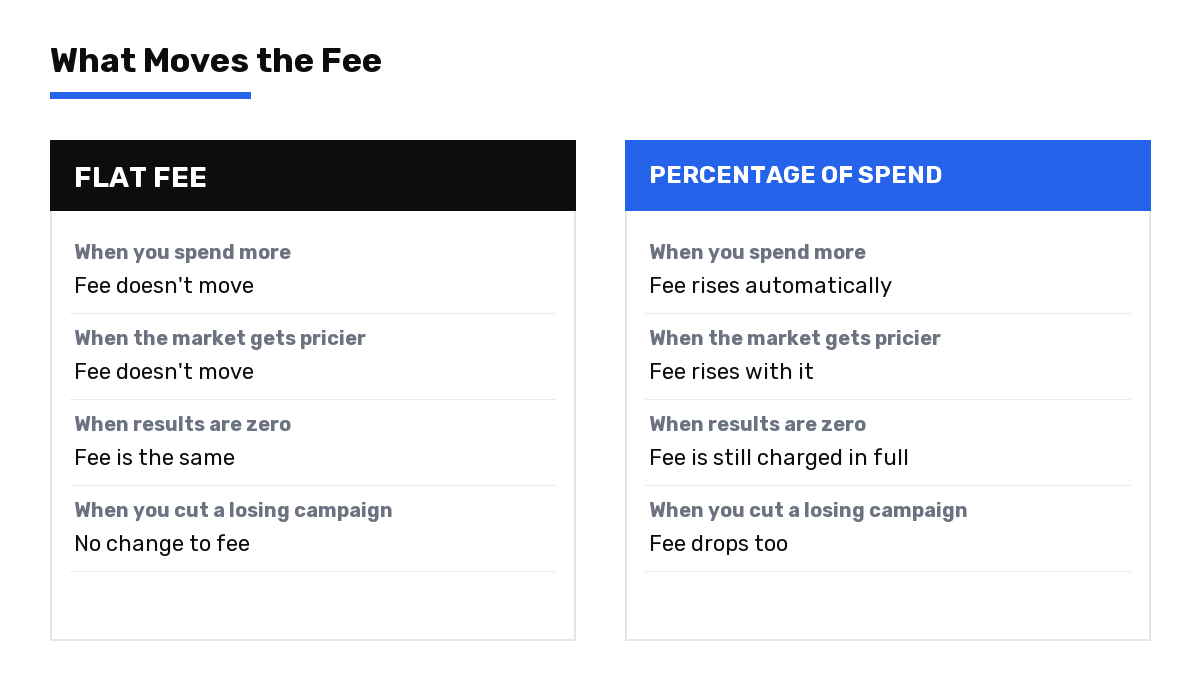
- What happens to the fee if I ask you to cut spend? Under a percentage deal, the honest answer is “it goes down.” Ask them to say that out loud.
- Is the account checked daily or monthly? This matters more than the pricing model itself. I’ve written the case for daily coverage separately in daily coverage versus monthly check-ins, and it applies under either fee structure.
- What’s the minimum spend this makes sense at? Below the break-even point worked out above, percentage genuinely can be the cheaper, fairer option. A good agency will tell you that unprompted, not wait for you to do the maths yourself.
The model on the invoice matters less than whether anyone’s actually looking at your account. A cheap fee attached to nobody checking pacing, rejections, or a dying ad set for three weeks straight costs more than either pricing structure ever will. If you want a read on what your own account is actually costing you right now, under whichever model you’re on, that’s a free teardown, not a sales call. There’s more on what AU Shopify stores should budget for Meta ads if you’re still working out the spend side of the equation first, before you even get to which fee structure sits on top of it.
Want the real number for your account, not a hypothetical?
Free teardown of your account: what you’re actually paying, what you’d pay under the other model, and what’s actually broken underneath both. Back in 48 hours, yours to keep either way.